Do you crave that perfect cup of coffee, rich in aroma and flavor, every single morning? The secret might not lie solely in your beans or your brewing method, but rather in a crucial step that often goes overlooked: grinding your coffee beans correctly. The way you grind your coffee directly impacts the extraction process, profoundly influencing the final taste in your cup. Whether you’re a seasoned barista or just starting your journey into the world of coffee, understanding How To Grind Beans For Different Types Of Coffee Makers is essential for unlocking the full potential of your brew. This comprehensive guide will walk you through the nuances of grind sizes, suitable grinders, and expert tips to ensure every cup is a masterpiece.
The Science of the Grind: Why Grind Size Matters for Your Coffee
At its core, brewing coffee is about extracting soluble compounds from coffee grounds using hot water. Grind size is one of the most essential variables when brewing the perfect cup, influencing extraction, flavor, and even texture. The smaller the coffee particles, the larger their total surface area. A larger surface area allows water to interact more quickly and thoroughly with the coffee, leading to faster extraction. Conversely, larger, coarser particles have less surface area, requiring more time for water to extract their flavors.
If your grind is too fine for a particular brewing method, the water will over-extract the coffee, pulling out bitter and undesirable notes. This can also slow down the water flow significantly, leading to a sludgy brew. On the other hand, a grind that’s too coarse will result in under-extraction, producing a weak, sour, or watery cup because the water hasn’t had enough time to dissolve the flavorful compounds. Achieving the “sweet spot” in grind size ensures a balanced, flavorful, and aromatic coffee.
Decoding Grind Sizes: A Visual and Textural Guide
Before diving into specific coffee makers, let’s establish a common understanding of various grind sizes. Think of these textures as a spectrum, each designed for optimal interaction with different brewing methods.
- Extra Coarse: Resembles whole peppercorns or cracked corn. Particles are large and distinctly separate. Ideal for very long immersion times.
- Coarse: Similar to chunky sea salt or breadcrumbs. The particles are still large and visible.
- Medium-Coarse: Has the consistency of rough sand. Grains are distinguishable but smaller than coarse.
- Medium: Comparable to regular sand or table salt. This is a common grind size, versatile for many methods.
- Medium-Fine: Finer than table salt, but not powdery. It feels gritty when rubbed between your fingers.
- Fine: Resembles powdered sugar or fine table salt. It feels smooth, but you can still detect individual particles.
- Extra Fine (Powder): The consistency of flour or talcum powder. It’s extremely smooth and clumpy when pressed.
Pairing Your Grind: The Right Size for Every Coffee Maker
Different coffee makers employ diverse brewing principles—from full immersion to pressurized extraction—each necessitating a specific grind size for optimal flavor.
French Press: Coarse Grind for Full Immersion
The French press is an immersion brewer where coffee grounds steep in hot water for an extended period, typically 3 to 5 minutes. This method requires a coarse grind, resembling chunky sea salt.
- Why it works: The large particles allow water to flow freely, preventing over-extraction during the prolonged contact time. A coarser grind also ensures that the mesh filter can effectively separate the grounds from the brewed coffee, minimizing sediment in your cup. Finer grinds would lead to over-extraction and can clog the filter.
- Texture: Chunky sea salt (approx. 690-1300 microns).
|
Our Picks for the Best Coffee maker in 2026
As an Amazon Associate I earn from qualifying purchases.
|
||
| Num | Product | Action |
|---|---|---|
| 1 | Cuisinart 14-Cup Coffee Maker, Programmable PerfecTemp Glass Carafe Coffee Machine with 1-4 Cup Setting, Brew Strength Control and Pause, Stainless Steel, DCC-3200BKSNAS, Black |

|
| 2 | Ninja 12-Cup Programmable Coffee Brewer, 2 Brew Styles, Adjustable Warm Plate, 60oz Water Reservoir, Delay Brew - Black/Stainless Steel |
|
| 3 | Cuisinart Coffee Maker, 14-Cup Glass Carafe, Fully Automatic for Brew Strength Control & 1-4 Cup Setting, Stainless Steel, DCC-3200CRM, Cream. |
|
| 4 | Cuisinart Coffee Maker, 14-Cup Glass Carafe, Fully Automatic for Brew Strength Control & 1-4 Cup Setting, Stainless Steel, DCC-3200GMP1, Gunmetal |
|
| 5 | Cuisinart 14-Cup Coffee Maker, Programmable PerfecTemp Glass Carafe Coffee Machine with 1-4 Cup Setting, Brew Strength Control and Brew Pause, Stainless Steel, DCC-3200WNAS, White |
|
| 6 | BLACK+DECKER 12-Cup Coffee Maker with Easy On/Off Switch, Easy Pour, Non-Drip Carafe with Removable Filter Basket, Vortex Technology, Black |
|
| 7 | BLACK+DECKER 12-Cup Digital Coffee Maker, Programmable, Washable Basket Filter, Sneak-A-Cup, Auto Brew, Water Window, Keep Hot Plate, Black |
|
| 8 | Cuisinart 14-Cup Coffee Maker, Programmable PerfecTemp Glass Carafe Coffee Machine with 1-4 Cup Setting, Brew Strength Control and Pause, Stainless Steel, DCC-3200NAS |
|
| 9 | BLACK+DECKER CM1160W-1 CM1160W 12-Cup Programmable Coffeemaker, White/Stainless Steel |
|
| 10 | Cuisinart Coffee Maker, 14-Cup Glass Carafe, Fully Automatic for Brew Strength Control & 1-4 Cup Setting, Stainless Steel, DCC-3200UMB, Umber |
|
Drip Coffee Makers: The Versatility of Medium Grind
Most automatic drip coffee makers use a percolation method, where hot water showers over a bed of coffee grounds and filters through. A medium grind is typically recommended for these machines.
- Why it works: A medium grind allows water to pass through at an even pace, extracting full flavors without bitterness or sourness. If the grind is too fine, water may struggle to flow, leading to over-extraction; if too coarse, water flows too quickly, resulting in under-extraction.
- Texture: Regular sand or table salt (approx. 300-900 microns).
Espresso Machines: The Precision of Fine Grind
Espresso brewing involves forcing hot, pressurized water through a compact “puck” of coffee grounds in a short amount of time. This intense process demands an incredibly precise fine grind.
- Why it works: The fine particles create significant resistance, allowing the high-pressure water to extract desirable substances rapidly, forming the rich crema and intense flavor characteristic of espresso. Even slight deviations can lead to over or under-extraction.
- Texture: Powdered sugar (approx. 180-380 microns).
- Tip: Espresso grind often needs “dialing in,” meaning you adjust it slightly finer or coarser to achieve the perfect shot time (typically 25-30 seconds for a double shot).
Pour-Over (V60, Chemex): Medium-Fine for Controlled Extraction
Pour-over methods like the Hario V60 or Chemex rely on gravity to pull water through a conical filter at a controlled rate. A medium-fine grind is generally ideal.
- Why it works: This grind size allows for even extraction as water passes through the coffee bed. Too coarse, and water flows too quickly, leading to under-extraction; too fine, and water chokes the filter, causing over-extraction and bitterness. Different pour-over devices may prefer slight variations; for example, a V60 often benefits from a slightly finer grind than a Chemex due to its ridged design facilitating faster flow.
- Texture: Finer than sand, coarser than espresso (V60: approx. 400-700 microns; general pour-over: 410-930 microns).
Moka Pot: Medium-Fine for Stovetop Richness
The Moka pot, a stovetop espresso maker, brews coffee by passing boiling water pressurized by steam through a bed of coffee grounds. A medium-fine grind is recommended.
- Why it works: This grind provides enough resistance for proper pressure buildup while preventing fine particles from clogging the filter or passing into the upper chamber. Bialetti, the inventor of the Moka pot, suggests a medium-fine grind that “feels gritty when rubbed between your fingers, but not powdery”.
- Texture: Gritty, between fine and medium (approx. 360-660 microns).
AeroPress: Adaptable Grinds for Diverse Brewing
The AeroPress is renowned for its versatility, allowing for various brew times and methods (e.g., standard, inverted). Consequently, it can accommodate a range from medium-fine to medium grinds.
- Why it works: Given its immersion and pressure-assisted filtration, the ideal grind depends on your specific recipe and desired brew time. A finer grind might be used for shorter, more espresso-like shots, while a medium grind works well for longer immersion brews.
- Texture: Medium-fine to medium (approx. 320-960 microns, highly variable by method).
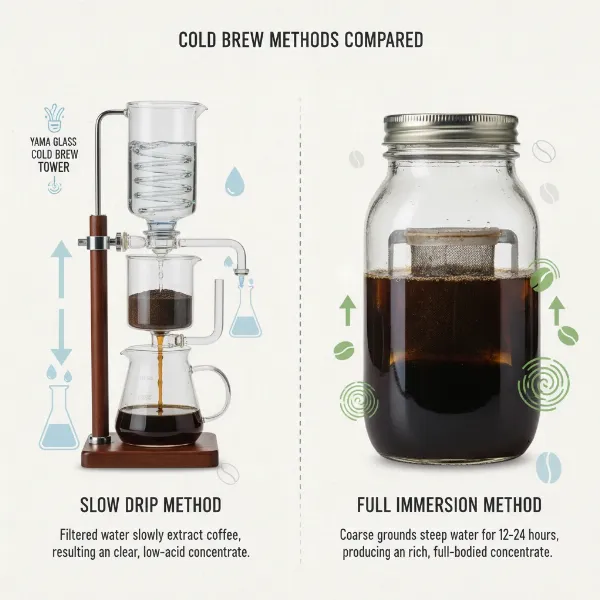
Cold Brew: Extra Coarse for Long, Gentle Extraction
Cold brew involves steeping coffee grounds in cold or room-temperature water for an extended period, typically 12-24 hours. This long, gentle process requires an extra coarse grind.
- Why it works: The prolonged contact time with cold water necessitates large particles to prevent over-extraction and bitterness. A coarser grind also makes filtration easier and reduces sediment in the final concentrate.
- Texture: Very chunky, like cracked peppercorns (approx. 800-1400 microns).
Turkish Coffee: Powder Fine for Traditional Brewing
Turkish coffee is unique because the finely ground coffee is simmered directly with water, and the grounds remain in the cup. This method demands an extra fine, powder-like grind.
- Why it works: This incredibly fine grind ensures maximum flavor extraction during the simmering process, creating a rich, intense brew with a characteristic layer of foam on top and sediment at the bottom.
- Texture: Flour-like powder (approx. 40-220 microns).
Choosing Your Weapon: Burr Grinders vs. Blade Grinders
The quality of your grind starts with your grinder. Not all grinders are created equal, and the type you choose significantly impacts the consistency and quality of your coffee.
Burr Grinders: The Gold Standard
Burr grinders are the preferred choice for coffee enthusiasts because they crush beans between two abrasive surfaces (burrs) to produce a consistent, uniform grind size. Consistency is key to even extraction. There are two main types of burr grinders:
- Conical Burr Grinders: These use a cone-shaped inner burr and a ring-shaped outer burr. They typically operate at lower RPMs, which generates less heat, preserving coffee flavor. They are often more affordable and are said to bring out brighter notes in coffee. Many excellent entry-level and professional grinders feature conical burrs.
- Flat Burr Grinders: These use two parallel, ring-shaped burrs. Coffee beans pass through the gap between them, resulting in highly uniform particles. Flat burrs are often associated with clearer, cleaner cups and are said to bring out darker notes. They can be louder and may require more frequent cleaning.
Blade Grinders: To Be Avoided
Blade grinders operate more like blenders, chopping coffee beans with a spinning blade. This method produces an inconsistent grind, with a mix of very fine “fines” and large “boulders”.
- The Problem: Inconsistent grind leads to uneven extraction. The fine particles will over-extract rapidly, creating bitterness, while the coarser particles will under-extract, resulting in weakness and sourness. The heat generated by the blades can also “cook” the beans, diminishing their delicate flavors. For a truly great cup of coffee, investing in a quality burr grinder is crucial.
“The grinder is the single most important tool for making great coffee at home. More important than your espresso machine, your sleek automatic brewer, or even the coffee beans themselves.” – CoffeeGeek, Renowned Coffee Resource
Grind Size Comparison Chart
To simplify your journey, here’s a quick reference chart for common brewing methods:
| Brewing Method | Recommended Grind Size | Texture Analogy | Approximate Microns | Key for this Method |
|---|---|---|---|---|
| Turkish Coffee | Extra Fine (Powder) | Flour | 40-220 | Maximizes extraction during simmering, grounds remain. |
| Espresso | Fine | Powdered sugar | 180-380 | High pressure, short contact time. |
| Moka Pot | Medium-Fine | Gritty | 360-660 | Stovetop pressure, prevents clogging. |
| Pour-Over (V60) | Medium-Fine | Finer than sand | 400-700 | Controlled gravity flow, even extraction. |
| Drip Coffee Maker | Medium | Table salt | 300-900 | Balanced flow rate for standard percolation. |
| AeroPress | Medium-Fine to Medium | Fine sand to regular sand | 320-960 (variable) | Versatile, depends on brew time and technique. |
| French Press | Coarse | Chunky sea salt | 690-1300 | Long immersion, easy filtration. |
| Cold Brew | Extra Coarse | Cracked peppercorns | 800-1400 | Very long, gentle immersion in cold water. |
Note: Grind settings on grinders are not universal. A “5” on one machine may differ from a “5” on another. Use the texture descriptions as your primary guide, then fine-tune based on taste.
Expert Tips for Perfect Grinding
Even with the right grinder and an understanding of grind sizes, a few expert tips can elevate your coffee experience.
Grind Fresh, Always
The moment coffee beans are ground, they begin to lose their aromatic compounds and flavor to oxidation. Grinding your beans immediately before brewing is the single most impactful step you can take to improve your coffee’s taste. The difference is truly astounding.
Measure Accurately
While grind size is paramount, the coffee-to-water ratio also plays a critical role. A general rule of thumb is to use 1-2 tablespoons of coffee per 6 ounces of water, but a kitchen scale for measuring grams of coffee and water offers superior precision.
Store Whole Beans Properly
Keep your whole coffee beans in an airtight container, away from light, heat, and moisture. Avoid storing them in the refrigerator, as condensation can degrade their quality. The freezer can extend shelf life but ensures beans are completely airtight to prevent freezer burn and odor absorption.
Clean Your Grinder Regularly
Coffee oils and fine particles can build up in your grinder, becoming rancid and imparting off-flavors to your fresh grounds. Follow your grinder’s manufacturer instructions for regular cleaning, often involving specialized cleaning tablets or brushing out residual grounds.
Don’t Be Afraid to Experiment
Coffee brewing is an art as much as a science. Use the guidelines as a starting point, but don’t hesitate to adjust your grind slightly finer or coarser based on your taste preferences, the specific beans you’re using, and even the ambient humidity. A slight adjustment can drastically change the flavor.
Common Grinding Mistakes and How to Fix Them
Even experienced brewers encounter issues. Here’s how to troubleshoot some common problems related to grinding:
- Your coffee tastes bitter and harsh: This is a classic sign of over-extraction. Your grind is likely too fine, causing too many soluble compounds to dissolve. Try adjusting your grinder to a slightly coarser setting.
- Your coffee tastes sour, weak, or watery: This indicates under-extraction. Your grind is probably too coarse, and the water isn’t spending enough time interacting with the coffee particles. Adjust your grinder to a slightly finer setting.
- Your brewer is clogging or flowing too slowly: An overly fine grind is the culprit. The particles are too small and compact, preventing water from passing through efficiently. Coarsen your grind.
- There’s too much sediment in your cup (especially French press): Your grind might be too fine, or your grinder produces too many “fines” (very small particles). Ensure you’re using a quality burr grinder and adjust to a coarser setting.
- Inconsistent flavor day-to-day: This often points to an inconsistent grinder (like a blade grinder) or a burr grinder that isn’t properly maintained or calibrated. Consider upgrading your grinder for better consistency.
Conclusion
Mastering the art of grinding coffee beans is a transformative step in your pursuit of the perfect cup. From the robust, full-bodied French press to the concentrated richness of espresso, each brewing method demands a specific grind size to unlock its unique flavor profile. By understanding the science behind extraction, choosing a high-quality burr grinder, and applying simple yet effective grinding techniques, you can ensure consistency and exceptional taste in every brew. Experiment with confidence, trust your palate, and enjoy the rich rewards of perfectly ground coffee. What new flavors will you discover by fine-tuning your grind today?
Frequently Asked Questions
Can I use espresso grind in a drip coffee maker?
While technically possible, using espresso-fine grounds in a drip Coffee Maker will almost certainly lead to over-extraction, resulting in a bitter, often sludgy cup, and could potentially clog your machine’s filter. It’s best to use the recommended medium grind for drip brewers.
How often should I clean my coffee grinder?
The frequency depends on how often you use it, but generally, a thorough cleaning every 2-4 weeks is recommended for burr grinders. Regular brushing out of grounds after each use can also help prevent oil buildup and maintain optimal performance.
What’s the difference between conical and flat burr grinders?
Conical burr grinders use a cone-shaped inner burr and a ring-shaped outer burr, often quieter and good for various brewing methods. Flat burr grinders use two parallel ring-shaped burrs, typically producing highly uniform particles for a clean cup profile, though they can be louder and may require more cleaning.
How do I know if my coffee is over or under-extracted?
Over-extracted coffee tastes bitter, astringent, or hollow. Under-extracted coffee tastes sour, thin, weak, or salty. Adjusting your grind size is the primary way to correct these issues: coarsen for over-extraction, fine for under-extraction.